


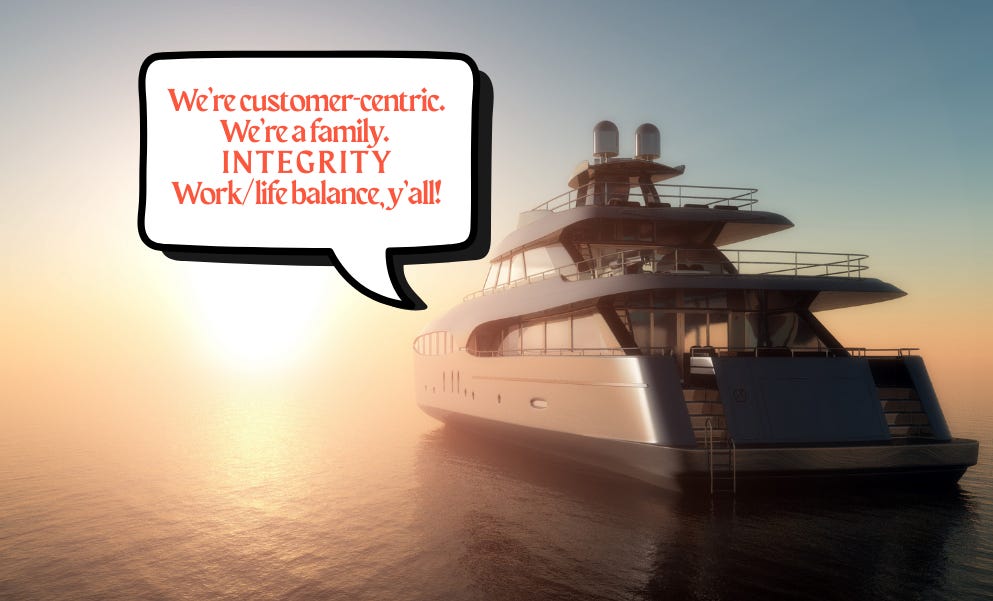
It’s a canon event in every career: the moment you realize that your employer’s stated values are not the same as their lived ones. Under capitalism and the patriarchy, it feels naive to think values alignment was ever possible in the first place. How silly of you to think a company cared about you, especially after it said it did on paper/the website!
The accepted myth of big business is that it is a space free from the “constraints” of values, their antithesis, even, or that it must necessarily be free of them to thrive. The invisible hand, y’all, that’s all we need! Some companies say they operate sans values with pride. Others state that they have certain values, then operate outside of them, which can be very confusing for employees and customers.
But I’m not talking about ethics, or what society tends to agree are “good” values that people and companies “should” have. I’m talking about what an individual or company’s values truly are in practice, free from judgment or ethical considerations.
If you pause for a moment and accept that good and bad are social constructs (an uncomfortable but useful exercise), then values are simply the principles an organization operates by, based on what matters to it. They are neither noble nor goodly, evil nor corrupt. They just are.
In my brand strategy consulting work, one of the important components I determine is brand values for all of my clients. Sometimes my clients say, “Oh no, we don’t have like an environmental or humanitarian aspect to our brand,” thinking this is what values refer to. I explain that it didn’t matter; every company operates based on a set of values. It doesn’t matter what those values are. It just matters that they are stated, known within the company, felt by the customer, and adhered to consistently.
A newer company has the opportunity to decide what its values will be. Maybe it’s a company that prioritizes the customer experience, where employees should be accountable for finding solutions, and where failing fast and taking action are encouraged. An existing company has to mix it up, take a look at how they are structured and already working to accurately capture what their values are in practice, and maybe implement some new ones if something isn’t working or isn’t clear to all employees.
The trick is to be honest about what your values are. If your bottom line depends upon gouging the customer, if you don’t have space in your budget (or don’t want to allocate budget) for a strong customer experience, for a well-supported CX team, for brand marketing to foster that customer relationship, then don’t look me in the eye and tell me you value your customers. You can’t; your business isn’t designed for that. Instead, say that you value speed and efficiency, that you value giving the lowest price to the customer, and that you’re a results-driven organization. Maybe you’re a place where individual performance is king, or where keeping shareholders happy is the main objective. Don’t feel bad if these are your values, and definitely don’t hide them; remember, we’re not talking about ethics, we’re talking about what matters to your business based on your activity choices.
Once you determine your values, make sure you live them. Acting counter to your values is bad for everyone who interacts with your brand, internally and externally. The human mind and heart don’t enjoy this dissonance, not to mention it’s just confusing for your employees.
Let’s say you’re that same company that can’t support the customer experience, but you state in your company values that you “value your customers.” Individuals working for you might spend time and energy keeping customers happy when that’s literally not part of your business strategy. They don’t have the resources necessary to provide this experience to customers, nor will they get them because CX doesn’t matter to you. They’ve wasted time on something that the company doesn’t value in practice, only in word. Either they’re at the wrong company, you’re misleading customers and employees, or both.
Customers feel the disconnect, too. If you market that you’re customer-centric, then offer a crappy experience, that chafe will piss them off. By contrast, if you market that your product is cheap and convenient, and don’t waste time selling an experience you don’t have, audiences with aligned values will self-select into your offering, without the chafe that ends up as negative reviews, returns, angry emails, etc. Gen Z is going to reinforce the hell out of this1; they care more about companies acting consistently than they do with what the values even are, so you’d better get aligned before Gen Z calls you out.
This is why value alignment is critical to business strategy. It’s not just a way to avoid dissonance and customer attrition, but a tool that can save time, help you arrive at decisions more easily, ensure the whole organization knows what is important, and attract audiences based on what you actually offer, not what you say you offer. Failure to do so will necessarily erode businesses over time, their connection with their customer and employees, and their reputation. Most companies still cop out; a shortsighted move that I hope we see less of as audiences become more savvy and leaders realize alignment isn’t a slog, it’s a tool.
“Duh,” you might be thinking, because the concept is so simple, it’s almost dumb. Well, taking aligned action with a company’s values can be tougher than you think, even if the values are sitting in a beautiful presentation deck, right in front of your face.
I once had a tech startup client for whom I was creating a brand strategy. I spent a few weeks interviewing stakeholders, ironing out their values, key talking points, brand voice, audience personas, etc. Then, one individual within the company tried to short-pay my final project fee. He tried to short-pay me at every stage, which is a huge red flag, and I should have exited the project the first time he got cagey with me. This dude actually typed out the words “can we come to an arrangement where everyone wins” as he made excuses for why he didn’t think he should have to pay me my full fee. After a few rounds of back and forth, I pointed out to him that the brand values I just outlined for his company, values he signed off on, included “we empower small businesses.” Yet here he was, trying to get out of paying a small business whose work he had just said he was happy with.
Dude did not like that I said this (maybe because a lot of people were copied on the email, including the CEO, maybe because he was a jerk), and accused me of character assassination. It’s actually one of the highest compliments I’ve ever been paid, although I can’t take credit; I didn’t assassinate his character at all. He did when he acted counter to his company’s stated values.
True, I lost ongoing business from this company, but they also lost access to my brand strategy expertise by acting inconsistently with their values. If you want to get really deep, I got myself in trouble with this project in the first place because I was inconsistent with my values as well: I’m supposed to be a premium, quality-focused shop taking on a small number of clients who appreciate the care I bring to my work, and I price my services accordingly. As soon as that client got weird about the project fee, I should have walked away, because it was clear we weren’t aligned. But I got greedy, I stuck it out, and had to learn a valuable lesson about sticking to what I’ve said matters to me.
That’s why there’s not only space for values in business strategy, but it’s impossible to separate one from the other. Trying to do so weakens your business and leads to writers commemorating your inconsistency on their Substacks.
It’s your job as a business leader to pinpoint what your authentic values are, then embody them in all of your choices, or suffer the waste and brand confusion that comes from being out of alignment.
Oh, and btw, don’t worry, that client did end up paying me.
If you want help with this type of alignment at your organization, learn about my strategic advisory engagements here.
If you’d like individual coaching to work on these concepts on a personal level, I do that too.